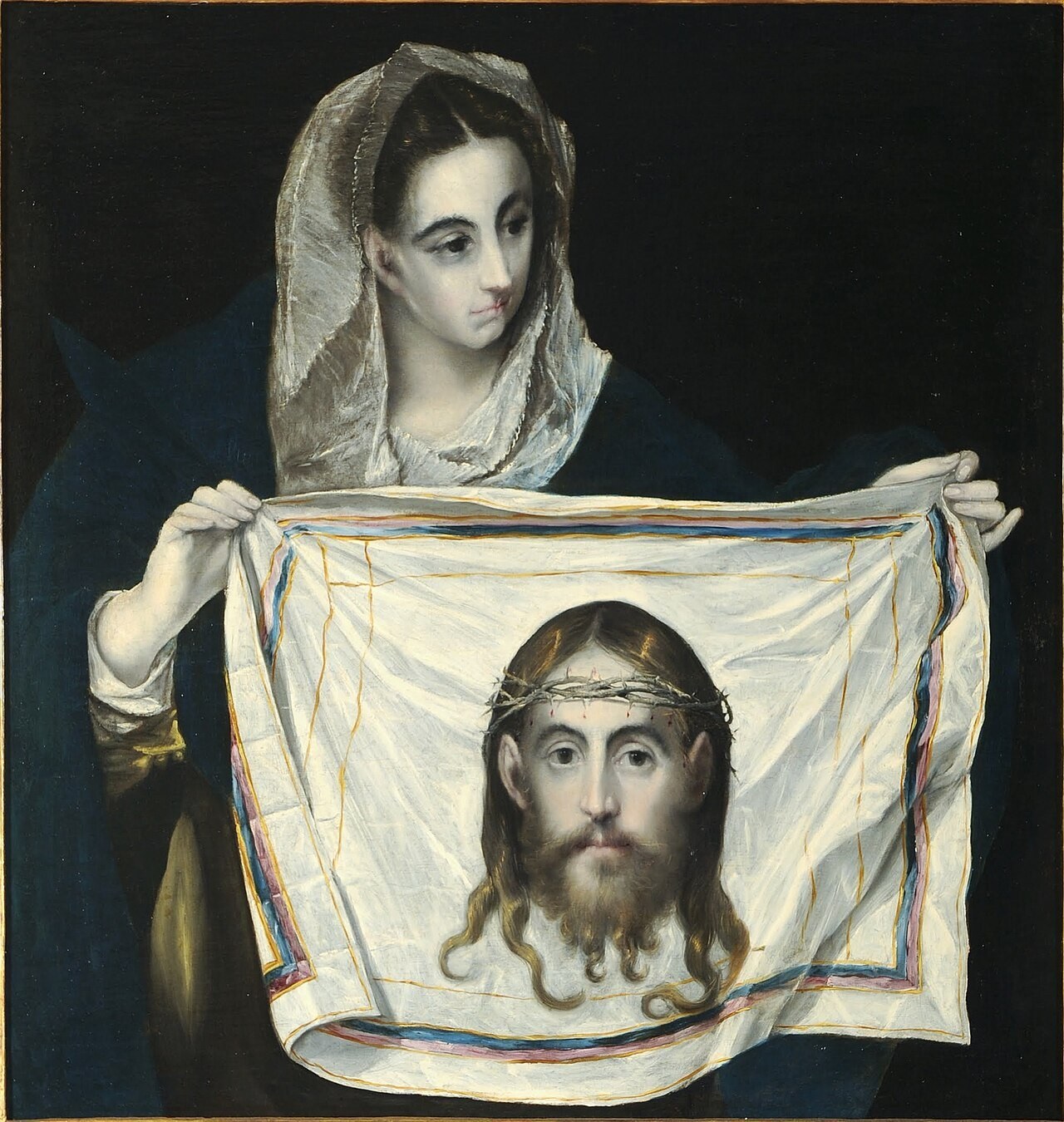
Verónica
"She held things up in the hall at eleven in the morning and then again at seven in the evening and said that the card was a lie told in a shop."
— Beautiful Scars, §8
Origin: Sebastián's wife is named after Saint Veronica.
History: Saint Veronica does not appear in the Gospels; her story survives through Christian custom. Tradition remembers her as a woman of Jerusalem who stood by the road as Jesus carried his cross to Calvary. Seeing Jesus suffering, his face covered in sweat and blood, she stepped out of the crowd and wiped it with her veil. When she took the cloth back, the image of his face was imprinted on it. Her story is commemorated at the sixth Station of the Cross, and by the fifteenth century pilgrims to Rome were being shown her veil in St Peter's Basilica.
Her name has two roots. The older one is Greek: Berenike, "she who brings victory." The other was given to her in the Middle Ages, when people read Veronica as vera icon, "true image": the one portrait of that face that no painter had made.
For centuries painters showed her the same way: a woman holding up a white cloth, and on it a face wearing a crown of thorns.
Sebastián calls her Vero. In Italian, vero means true. Verónica represents the true image of mankind in the novel.
What does the perfect version leave out, of other people and of you?