

What should never happen has no name
The missing word
“In Spanish, he said. Give me that in Spanish. Or in English, since you have both, give it to me in English.”
— Beautiful Scars, §31
In the novel, Elías, who teaches Hebrew, stops Sebastián on the sidewalk, says a single word, and puts two fingers on his chest, near the collarbone. Sebastián has nothing to give him. The book never translates the word.
The word: It is shakul (שַׁכּוּל). In Hebrew it means bereaved: one who has lost his children. A mother is shakula, and the grief itself is shchol. The word is as old as the Bible. In the Book of Genesis, Jacob, afraid of losing his youngest son, says: “If I be bereaved of my children, I am bereaved.” Arabic has a word from the same ancient root, thaklā, a mother who has lost her child.
English and Spanish have words for the other losses. A child who loses a parent is an orphan, huérfano. A woman who loses her husband is a widow, viuda; a man who loses his wife is a widower, viudo. For a mother or a father who loses a child, neither language has a word. You can only express this pain by using a phrase or a complete sentence.
Why do both English and Spanish have this apparent lexical gap? In the natural order of life, children are supposed to bury their parents. When the order is reversed, the language has nothing to offer. What should never happen has no name.
In the novel, the order has already blurred. At a twenty-fifth birthday party, a girl stands between her two grandmothers, who look about six years older than she does.
How do we endure a grief our language refuses to name?
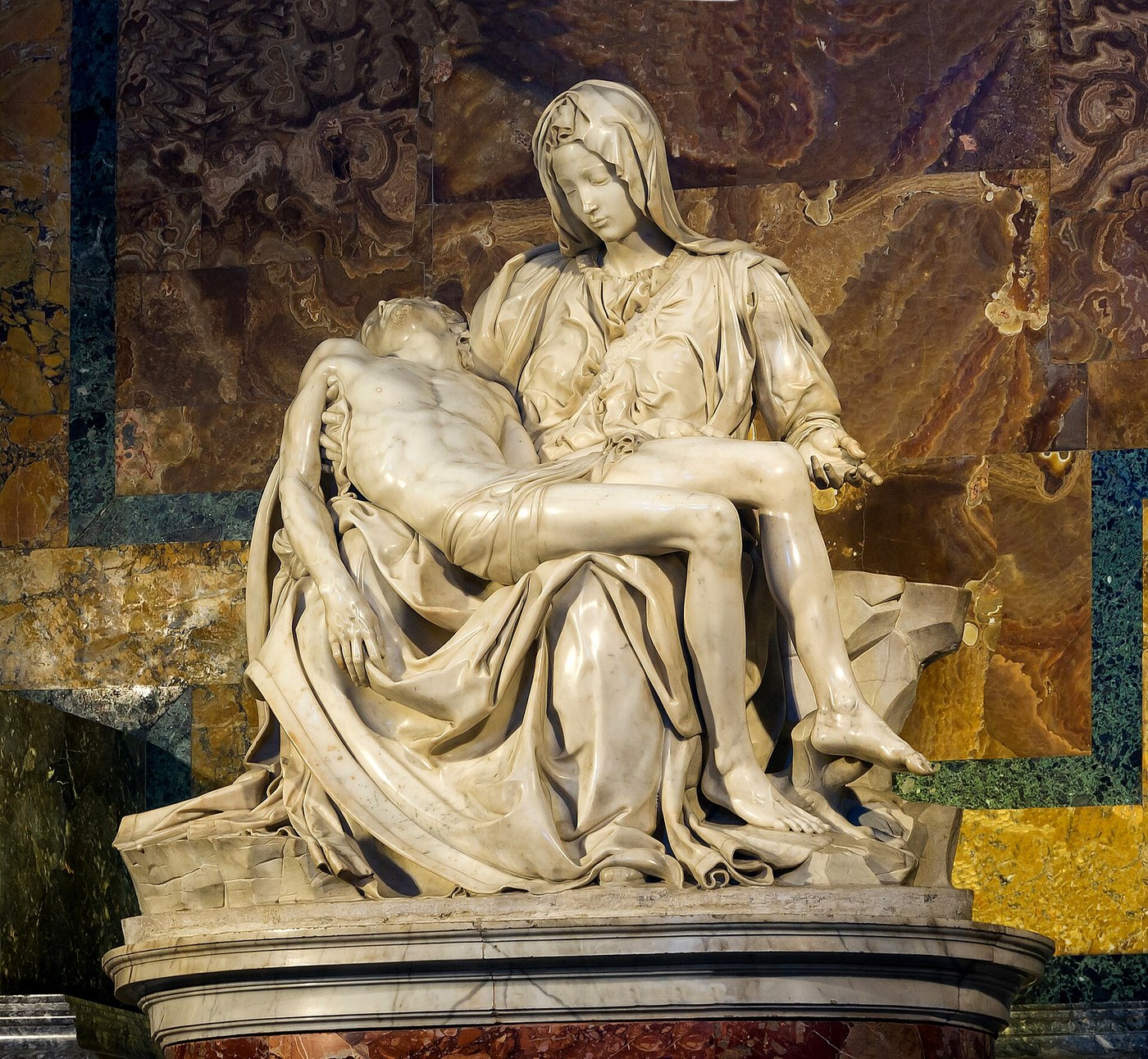
Michelangelo carved the Pietà from a single block of Carrara marble in 1498 and 1499. It is the only work he ever signed: his name runs across the sash on Mary’s chest. In 1972 a man attacked it with a hammer, striking it fifteen times; Mary lost her arm at the elbow and part of her nose. It was restored, but some of the original marble was never recovered. It stands in St Peter’s Basilica, between the Holy Door and the altar of Saint Sebastian.
The next section is intended to be read once you have finished the book.
I’ve finished the bookClose
Weeks later, on a Thursday night, Sebastián takes down two dictionaries and looks for the word himself: under padre, madre, hijo, luto, duelo, then again in English. He finds huérfano, viuda, even compadre, a word nobody has needed in fifty years, still waiting in eight-point type. “There is no word.”
In the novel the order breaks in another way too. Dr. Alegría’s twelve young patients died at twelve, thirteen, fourteen, while the cure waited in offices for sixteen years.