María Soledad
"Her mother chose it, in the week after she was born, out of a small red book of saints that had belonged to her own mother."
— Beautiful Scars, §9
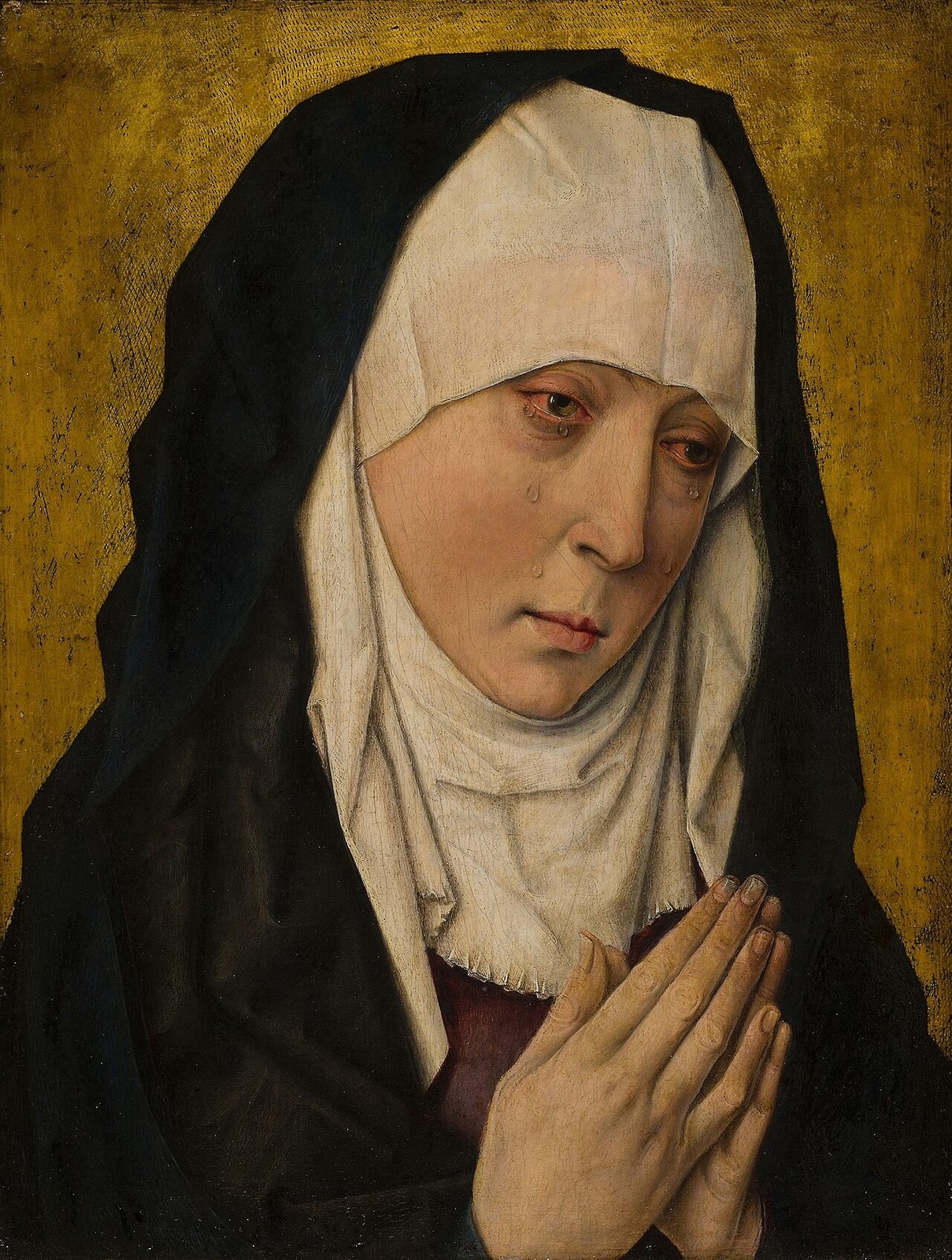
Origin: Sebastián's daughter is named after Our Lady of Solitude, also known as María de la Soledad.
History: Our Lady of Solitude is one of the most deeply revered titles of the Virgin Mary. It remembers her on Holy Saturday, the day after the Crucifixion, when her son, taken down from the cross, lay in the tomb, leaving her alone with her profound grief.
The devotion grew in Spain. In 1565, in Madrid, the sculptor Gaspar Becerra delivered a statue of the Virgin of Solitude to the convent of Our Lady of Victory. She was dressed in the mourning clothes of a noble Spanish widow, modelled on those of the Countess of Ureña, and from then on the Virgin of Solitude was shown as a widow. The image crossed the ocean with the Spanish. Today she is the patroness of the state of Oaxaca, in Mexico, where her basilica was completed in 1690. She is commemorated in Spanish-speaking countries on the 18th of December.
From a theological viewpoint, Our Lady of Solitude represents the grieving mother that withstands the emotional isolation of a parent who has buried a child.
As a name, María de la Soledad is often shortened to Soledad, or to Marisol. In Spanish, soledad means solitude. The dictionary of the Real Academia Española gives it a third meaning: the sorrow felt for the absence, death, or loss of someone.
Sebastián calls her Sol. In Spanish, sol means sun.
How do we endure a grief our language refuses to name?